
Monterey Peninsula Real Estate: 2025 Year in Review & 2026 Predictions

2025 was a fascinating year to watch and talk real estate on the Monterey Peninsula. Often, people created their own narratives about what they thought was happening. But what really happened? Every community told a different story – just like we have micro-climates, we have distinct micro-markets.
Now that the data is in, we have a complete picture of 2025. I'm here to share the data across seven key Monterey communities, how to interpret it, and what it means moving into 2026.

Community Summaries
Marina | Population: 22,000+ | Highest sale in 2025: $2.26M | Lowest sale: $490k
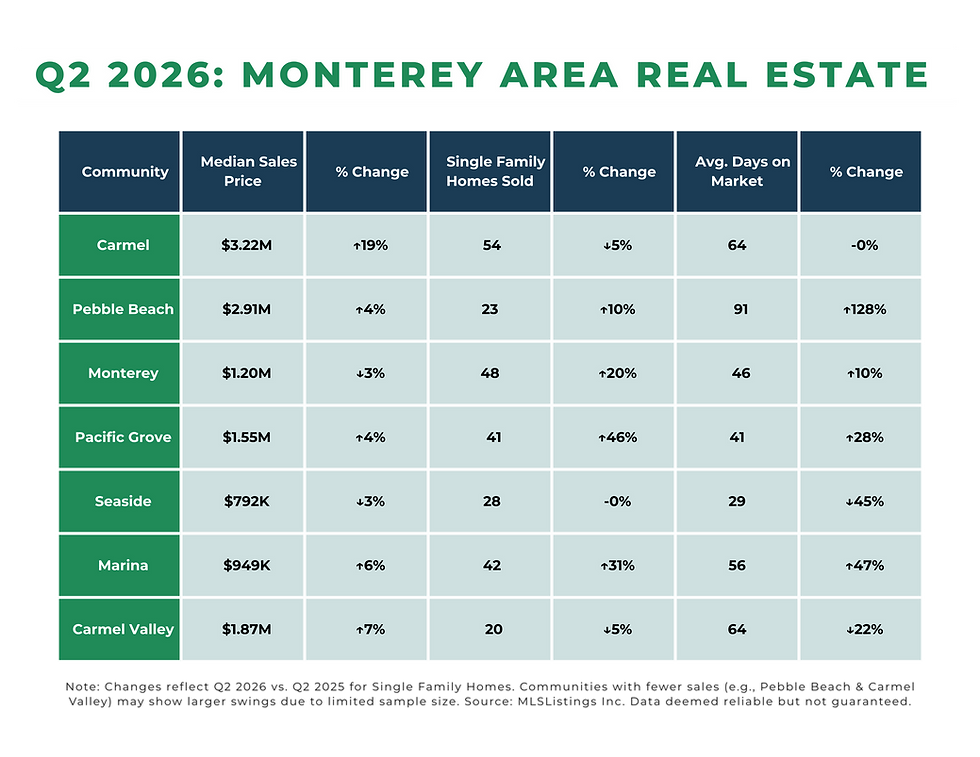
The data shows what we know: Marina remains the most affordable gateway to the Monterey Peninsula with its $520 price per square foot – the lowest of the seven communities discussed here. This market appeals to buyers who value affordability, square footage, yet still want coastal proximity. Marina is also evolving with new amenities like Trader Joe's and boutique fitness studios and a growing CSUMB campus. The market here features large new construction homes on Marina’s higher end ($1.3M) as well as more cost-conscious, established single-family ranch-style homes ($750k+) and condos ($500k+). While the $900K median reflects the combination of these housing options, Marina offers great value for different price points primarily under $1.5M. Though homes took 20% longer to sell in 2025 (48 days on average) and prices softened 3%, Marina maintained a solid sales-to-list ratio at 98.9%.
Seaside | Population: 32,000+ | Highest sale in 2025: $2.67M | Lowest sale: $430k
Seaside is a price-accessible market in our area with its median home price of $787K. Seaside offers many tract-style ranch homes along sidewalk-lined streets original to its roots as a former military community. Given its affordability, evolving Broadway Ave corridor with popular places to hang like Other Brother Beer, as well as its proximity to Monterey, it's a popular choice for first-time buyers and families. The market still favors sellers given limited housing supply. Notably, the 5% increase in price per square foot ($679) despite the 4% drop in median price suggests a compositional shift – potentially more smaller homes sold versus larger homes in 2025, which can be common in affordable markets during periods of economic uncertainty.
Monterey | Population: 30,000+ | Highest sale in 2025: $6.45M | Lowest sale: $419k
Monterey, my chosen city, is the Peninsula's heartbeat. With its diverse housing options – from Del Monte beachfront condos, historic adobes, the ever-popular California ranch homes and condominiums sprinkled in neighborhoods throughout, to midcentury modern hideaways tucked along its many hills – Monterey attracts a wide range of buyers. The market showed steady appreciation with a 5% increase in median price to $1.15M, but the pace notably slowed. Average days on market jumped 50% to 54 days, indicating that the urgency to buy walked out the door. Sellers still had pricing power, but buyers now had more time to deliberate and negotiate than they did in 2024. This represented a more balanced market in 2025 where neither buyers nor sellers held outsized leverage, and where patience and realistic pricing yielded the best results.
Pacific Grove | Population: 15,000+ | Highest sale in 2025: $7.3M | Lowest sale: $625k
Pacific Grove has all the architectural charm, a growing business district, and dramatic coastal scenery. In 2025, the median price declined 11% to $1.33M, which I find to be a tad surprising. Given how small the market is (147 total properties sold in 2025), it’s likely that the mix of properties sold encompassed a larger number of smaller homes. Regardless, demand remained strong and inventory still limited. Total properties sold increased by 22% in 2025, and homes moved at an average of 41 days on market (faster by 9% than in 2024). Sellers still had to be realistic about pricing more than in previous years, but Pacific Grove's unique blend of coastal access, excellent schools, and protected community character ensured well-priced homes found buyers quickly.
Carmel | Population: 3,200+ | Highest sale in 2025: $17.5M | Lowest sale: $440k
Carmel includes the coveted one square mile of Carmel-by-the-Sea, the village known for its fairy-tale cottages and European ambiance. It commanded the highest price per square foot ($1,389) of all communities discussed. However, the combination of an 8% price decline to $2.18M, 30% longer selling times (69 days), and reduced transaction volume (-2%) suggests meaningful market rebalancing after the peak pricing levels. Rebalancing is good, right? Well-priced properties still sold given Carmel's enduring appeal and cultural cachet, but sellers needed realistic expectations and patience compared to previous years. The village's walkability, art galleries, and coastal proximity ensured continued demand – just at a more measured pace.
Pebble Beach | Population: 3,600+ | Highest sale in 2025: $18.1M | Lowest sale: $700k
Pebble Beach, with its world-class golf courses and coastal estate living, demonstrated the healthiest market dynamics of any community analyzed. The luxury enclave saw a 23% increase in sales volume (97 total homes sold), faster transaction times (55 days, down 7% from 2024), and stable pricing (up 1% to $2.66M). This luxury segment appears relatively insulated from broader market pressures, likely attracting well-capitalized buyers less sensitive to interest rate fluctuations. This was a seller-friendly market that remained balanced with strong demand but without the overheating that characterized previous years.
Carmel Valley | Population: 6,200+ | Highest sale in 2025: $7.82M | Lowest sale: $430k
Carmel Valley presents an intriguing paradox: prices remained stable with modest 1% appreciation to $1.59M and sales volume increased 4%, yet homes took dramatically longer to sell – 89 days on average, up 33% from 2024. This data suggests that the demand exists but buyers were highly selective and deliberate. The extended selling time may reflect challenges securing homeowner's insurance in this very high fire-risk zone, which added complexity to transactions. Sellers needed patience and competitive pricing, but the data confirms transactions still happened for well-positioned properties. The valley's sunny microclimate, access to highly-rated Carmel schools, and family-friendly atmosphere continued to attract buyers, but at a more measured pace than in previous years.
What to Expect in 2026
Even though it feels like there's a lot happening in the country, the things that make the Monterey Peninsula desirable aren't changing: stunning coastline and access to nature, high-end amenities, excellent schools, ideal weather, and communities with distinct character. Turns out people just wanna live here – like us!

Based on the data, economic analysis, and this crystal ball (pictured left), I think we can expect a continuation of 2025's more balanced market conditions – home prices won't drastically increase, but supply constraints and steady demand will remain. Economists expect mortgage rates to continue in the low 6% range, so first-time buyers who've been watching from the sidelines may find this is as good a time as ever to buy. For sellers, the key will be competitive pricing from the start: overpriced homes will languish, but well-positioned properties will continue to attract serious buyers.
The luxury segment appears well-positioned to maintain momentum given its appeal to buyers less impacted by mortgage rate fluctuations. Meanwhile, markets like Marina and Seaside will likely continue attracting first-time buyers and families seeking Peninsula proximity at accessible price points. And with the trendy, new Kimpton hotel opening in downtown Pacific Grove, I anticipate that it will entice more tourists to become PG locals.
If you're thinking about making a move in 2026, I'm always here to help you understand what's happening in your specific neck of the woods and develop a strategy that aligns with your goals. Reach out anytime.
Thanks for reading!
Ashley

Comments